
Uilleann Pipes
Uilleann pipes have a sound that takes us to a mystical place. You don’t just hear them, they paint pictures of misty mountains and far cliffs, you feel the emotion; the anger of the famines, the pain of separation, the joy of reunion and the shared love of Ireland.
When the pipes join the refrain it’s like the world stands still to listen – they are that special.

A brief history
The present form of pipes only started to emerge in the early eighteenth century.
Simpler forms had been already around for well over a thousand years back to the time of St Padraig (St Patrick). Early writings refer to pipers as the “cuisleannach” (pipe blower).
They were fairly similar to Scottish pipes until somewhere around the seventeenth century when bellows stared to replace mouth blown instruments and the Irish pipes started to go their own way.
Development
Development continued throughout the eighteenth century and beyond to become the far more complex pipes we recognise today. The addition of, keyed chanters and regulators created the unique sound and challenge for players.
Image: Karen Schneider
The sum of the parts
Stay with us on this one it gets complicated.
Put simply, the Uilleann pipes have a bag, bellows, a chanter, drones and regulators.
The Bag is traditionally leather but more recently synthetic materials have been used. It sits under the left arm and players can increase or decrease the pressure with their arm to affect the note.
Bellows strapped under the right arm of the player inflate the bag. Because the bellows supply dry air as opposed to the moist air of mouth blown pipes a more slender reed can be used. This is a game changer, Scottish pipes for example have a range of 9 notes, uilleann pipes can easily span 2 full octaves (24 notes) and master pipers have reached all notes in the third (36 notes).
Now it gets really complex so deep breath and…

image: Pipers.ie
The regulators have several note-holes like the chanter but in this case closed by sprung keys and the regulators are sealed at the bottom. The standard set of pipes has three regulators and lie across the player’s lap above the drones.
By pressing three adjacent keys they sound a chord and are usually played with the side of the hand that is at the same time playing the melody on the chanter.
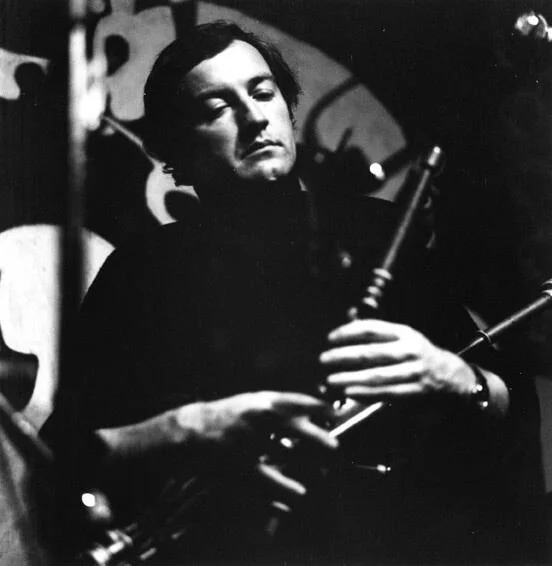
Liam O’Flynn RiP. 1945 -2018
One of the greatest pipers of our time and a gentle Irish man. His like may not be seen again and the world is a sadder place without his haunting sound. Thankfully we have a lifetime of recordings including collaborations with a wide range of musician from different traditions. If you need your spirits lifting listen to An Droichead (The Bridge) with Mark Knopfler.
Thanks for staying with us, you may have guessed we love this instrument and the amazing men and women who play them.
Chanter is the melody section, it plays the tune. It is a woodwind instrument with a double reed traditionally made of cane but now can be synthetic. Think of a flute connected to the bag and you won’t be far wrong.
It has ten note holes, closed with the fingers and thumbs. It is open at the bottom, and the note sounded with the bottom open and all the finger holes closed is known as “the keynote”.
Some pipes, for example Northumbrian pipes, have a closed chanter giving a distinctive punchy staccato sound. Others, like the Scottish pipes have an open-ended chanter and so notes are sustained.
Uilleann pipers have both options. The instrument is played sitting so the chanter can be open or closed by pressing the end against the knee.
So lets take stock. So far the player is using fingers and thumbs on the chanter, the right elbow to pump the bellows, the left arm to control the pressure and the knee to open and close the chanter. Still with us because there’s more?
Drones are simple pipes that are tuneable to play a continuous note. These drones don’t fly.
On the Uilleann pipes they can be switched on or off by means of a stop-key, and are tuned with sliding parts – think of the way a slide trombone works.
There are usually three drones, one tuned to the lowest note of the chanter and the others one and two octaves below that. The drones are set into a stock (which is tied into the bag), and they lie across the player’s lap.
Thank goodness, once they are tuned the player has little to do with them except turn them on and off.
Got it? Well just in case, lets recap
The piper is using fingers and thumbs on the chanter, the side of the hand on the regulator, the right elbow to pump the bellows, the left arm to control the pressure and the knee to open and close the chanter.
They are doing all this at a blistering pace whilst listening to the other players to keep tempo and play in sympathy with the other instruments.
Other pipes may have some of the components in common but none bring them all together in this way.
The Pipers
Uilleann Pipers are a breed apart, Some of our favourite modern pipers to listen out for.
Liam O'Flynn (RiP - 1945 -2018) - Planxty
Séamus Ennis (RiP – 1918 – 1982) - The Halfpenny Bridge Quartet
Paddy Keenan - Bothy Band
Davy Spillaine – Moving Hearts
Paddy Moloney – The Chieftains
Cillian Vallely - Lúnasa, Riverdance
Mick O'Brien
Tiarnán Ó Duinnchinn
In the past piping was something of a male domain with some notable exceptions like Nance the Piper and Kitty Hanley in the eighteenth century. More recently Margaret Murphy (1893–1973), or Mrs J.J. Murphy as she was also known, who was the first woman to win the Oireachtas uilleann piping competition in 1914.
Nowadays some great female pipers are finding their way onto a world stage. Amongst others, watch out for
Catherine Ashcroft
Amy Campbell
Tara Howley
Louise Mulcahy